
Cat Do You Have A Mom?
13/10/2026
82
53
10
Explorations is a collection of 4 emblematic works of Rene Magritte, recreated with current technology and the power of 3D modeling and animation.
Starting with

'Sheherezade is the name given to the pearl-woman object in memory of The Thousand and One Nights' (Magritte, quoted in D. Sylvester & S. Whitfield, René Magritte, Catalogue raisonné, vol. II, Oil paintings and objects, 1931-1948, Antwerp, 1993, p. 387).
Shéhérazade appears to have been painted in May 1947 and is considered to be one of the earliest pictures to feature one of René Magritte's iconic motifs, the pearl woman. This picture shows the woman, whose mouth and eyes are shown as islands of flesh surrounded by a mysterious framework of strings of pearls, against a backdrop of a sky hewn out of monumental arches of blue. Next to her on the tabletop are two tall pyramids, a glass of water and a thick, claret-coloured curtain. This manages both to invoke the tradition of the Old Masters of Magritte's native Belgium and also to create an intimacy, a domesticity, a normality, lulling the viewer into a false sense of security that is prised apart by the mirage-like vision of the woman who so bracingly stares out from the canvas like some Orientalist incarnation of the Cheshire Cat. She is some form of apparition, perhaps conjured by the rituals of which the pyramids and water may be the paraphernalia. At the same time, she is the alluring and ornate hostess introducing the viewer to a world that has been rearranged in order to reveal its infinite wonder.

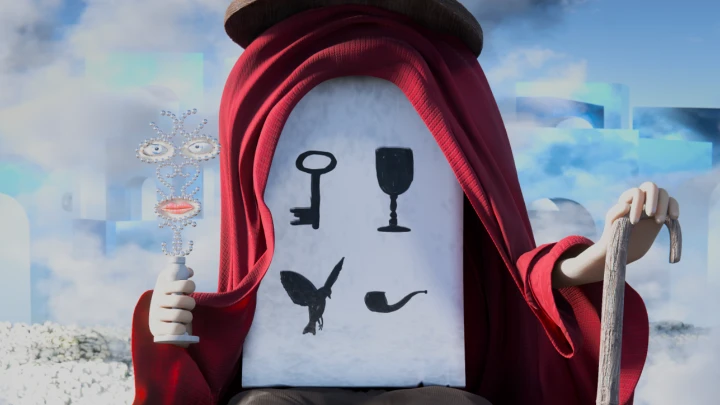
'The Liberator' presents a mysterious scene likely intended to provoke thought and curiosity. It depicts a figure seated against a surreal backdrop of floating architectural structures, with soft clouds embedded within. The figure, shrouded in a red cloak and adorned with a straw hat, lacks a discernible face; instead, there are symbolic images such as a key, a wine glass, a bird, and a pipe on a blank canvas where the torso should be. The enigmatic character holds a peculiar wand-like object topped with a bouquet of facial features and eyes. The figure’s attire and the walking stick it holds suggest a sense of journey or pilgrimage, while the suitcase placed by its side further emphasizes this theme. The overall composition resonates with Magritte’s distinctive style, blending reality with dreamlike elements to challenge perceptions and evoke deeper interpretations.

In 1948, while musing on the purpose of the titles he assigned to his paintings, René Magritte proclaimed: “I think the best title for a picture is a poetic one. In other words, a title consistent with the more or less lively emotion we feel when we look at the picture”. Across a series of handwritten manuscripts—now preserved in the Archives of Contemporary Art in Belgium and collectively known as “On Titles”— the artist offered a collection of short statements on some of his recent work. Among these brief notes, Magritte wrote about Les droits de l’homme: "Here, man is reminded of his right to act on objects and change the world"

The Annunciation brings together many of the themes, both iconographic and philosophical, that engaged Magritte during his stay in Paris from 1927 to 1930, a period in which he was closely associated with the French Surrealists. The painting shows an unlikely combination of objects. Two large bilboquets (Magritte's term for the objects in his works, which, though imaginary, recall wooden balustrades or chess-pieces) stand next to an oddly shaped piece of paper with a decorative cut-out pattern. Behind them looms a grey metal 'curtain', hung with sleigh bells. Despite its incongruity, this collection of objects seems disconcertingly 'at home' in the rock-strewn landscape beneath the grey clouds in the blue sky. The size of the painting (it is one of the largest the artist ever executed), together with its traditional composition and subtle allusions to paintings of Old Master like Leonardo da Vinci, Titian, and Caravaggio, are signs of the ambitiousness of the work.


![I Miss My Wife [Stop Motion]](https://picon.ngfiles.com/1056000/flash_1056399_card_fallback.jpg?f1791847906)

