←Back to Wiki
hathor
📅 Updated:2026-01-26
🕒 Created:2026-01-26
🆔 ID:91830
Description
Description
Quote from https://en.wikipedia.org/wiki/Hathor :
[quote]Hathor (...) was a major goddess in ancient Egyptian religion who played a wide variety of roles.
[quote]Hathor (...) was a major goddess in ancient Egyptian religion who played a wide variety of roles.
As a sky deity, she was the mother or consort of the sky god Horus and the sun god Ra, both of whom were connected with kingship, and thus she was the symbolic mother of their earthly representatives, the pharaohs.
She was one of several goddesses who acted as the Eye of Ra, Ra's feminine counterpart, and in this form, she had a vengeful aspect that protected him from his enemies.
Her beneficent side represented beauty, music, dance, joy, love, sexuality, and maternal care, and she acted as the consort of several male deities and the mother of their sons. These two aspects of the goddess exemplified the Egyptian conception of femininity.
Hathor crossed boundaries between worlds, helping deceased souls in the transition to the afterlife.
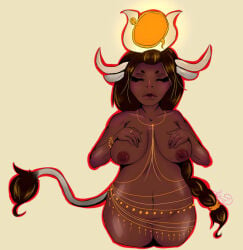
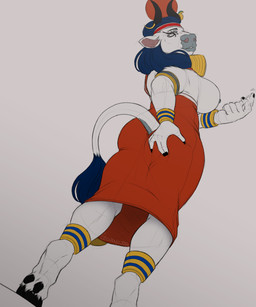
Hathor was often depicted as a cow, symbolizing her maternal and celestial aspect, although her most common form was a woman wearing a headdress of cow horns and a sun disk. She could also be represented as a lioness, a cobra, or a sycomore tree.[/quote]
The goddess Sekhmet is often considered to be an aspect of Hathor: In stories, Ra decides to send Hathor to destroy the people who rebel against him - whereupon Hathor transforms into Sekhmet.
Synonyms
[sup]*1[/sup] [sub]In ancient Egypt, the west and the desert were both associated with the land of the dead.[/sub]
- Mistress of Dendera (Dendera was the center of her worship)
- Lady of the desert (because of her role welcoming the dead[sup]*1[/sup] to the afterlife)
- Mistress of the West (because of her role welcoming the dead[sup]*1[/sup] to the afterlife)
Symbols and associations
- Cows
- The milky way
- Sun-disc (of Ra, not Aten's)
- The eye of Ra