←Back to Wiki
sound_effects
📅 Updated:2026-07-24
🕒 Created:2014-03-11
🆔 ID:4691
Description
In visual entertainment, sound effects are used as a method of storytelling or making a creative point without dialogue.
Table of contents [#top]
What are sound effects?
- A type of effect that represents an event, or action through sound, or a representation of sound. [sub]A sound effect can represent an action, even if that action is not known to produce a sound.[/sub]
Tagging guide ^[#taghelp]
How to tag sound effects ^[#howtotag]
Knowing common synonyms can be helpful
- Action sound effects are often stored in umbrella tags for a common action. See pulling_sound_effect
- Actions that do not have their own dedicated sound effect tag (i.e. throbbing) are usually stored in a sound effect umbrella category based on the nature of the sound.
For a list of examples, see Sound categories
Use the site's tag autocomplete to make finding tags easy
- The common form can often be found by typing the unknown sound effect into the tag box and seeing what pops up.
- Modified spellings are usually still stored in the base form. Do not worry too much if there are extra, or missing letters.
- Vowel shifts are often stored in a single tag for simplicity.
Examples
[quote]
[/quote]
- Use splurt to represent both "Splrt", and "Splurrt".
- Use bwomp to represent both "Bwump" and "Bwomph". Do note that fwomp is a different form.
Check the tag group
For a mostly complete list, see tag_group:sound_effects.
Action tagging ^[#actiontagging]
This section describes how to tag actions when there are sound effects present.
Identify the purpose
- Ask yourself if the form represents contact, movement, or something else, and determine what action is being represented.
Tagging guidelines
- Action tags may be tagged based on sound effect usage in most cases.
- Complex actions such as sex are not taggable if they are offscreen, but most lewd noises can be tagged in any situation.
- A sound effect can be associated with several action concepts that are related in an artistic sense, but not a tagging sense.
Example
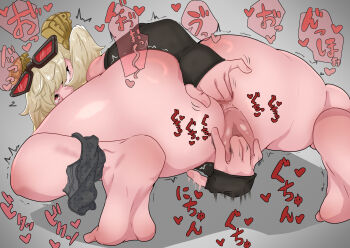
This image shows a kissing, and a swallowing sound effect being used as an interpretive mechanic. For the sake of simplicity, sound effect concepts can be used in a literal, or interpretive application.
thumb #2390655 This should neither be tagged as kissing, or swallowing, but it still contains a kissing, and swallowing sound effect.
Creating new tags ^[#newtags]
Factors that should be considered before starting a new sound effect tag:
- Does a tag already exist?
- Keep in mind that the tag used to store a sound effect may not be spelled the same as it appears in an image. Lookup tables are provided in the tag group if unsure.
Advanced techniques ^[#lettershiftintro]
Tag Formats ^[#tagformat]
[#taggroup]
Foreign sound effects ^[#foreign]
Include here information on how to translate sounds effects in different languages into their English equivalent tags.
[#soundgroup]
[#faq]