←Back to Wiki
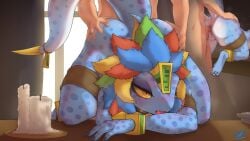
lizardman
📅 Updated:2026-08-05
🕒 Created:2023-02-12
🆔 ID:48922
Description
The lizardman is a creature appearing variously in folklore, fiction, and urban legend. Modern legends include cryptids such as the Lizard Man of Scape Ore Swamp and conspiracy theories that world leaders are shapeshifting reptilian aliens.
The origin of the lizardman is unknown, but it is likely an amalgamation of various mythological reptilian humanoids, such as the Nagas of Hindu and Buddhist mythology, the Dragon Kings of Chinese mythology, and the Egyptian crocodile god Sobek.
Lizardmen have since become a popular feature of modern fantasy and science fiction literature, games, and movies. Specific examples of this species in modern fiction include:
- the aforementioned Reptilians in conspiracy theories.
- the Argonians of The Elder Scrolls series.
- the Lizardmen of Warhammer, also known as the Seraphon.
- the Lizardmen of the Overlord series.
- the Lizardfolk of Dungeons and Dragons (D&D).
- the Lizards of Divinity: Original Sin 2.
- the Lizardmen of That time I got Reincarnated as a Slime that evolve into Dragonewts.
- the Lizardmen of the Soulcalibur series.
- the Iksar from Everquest.
- the Gorn from Star Trek.
- the Silurians from Doctor Who.
H4. Tagging guidelines
As "lizardman" is a generic term referring to various discrete but related fantasy creatures, akin to dragon and werewolf, it should not be confused with real-life species.
As "lizardman" is a generic term referring to various discrete but related fantasy creatures, akin to dragon and werewolf, it should not be confused with real-life species.
A lizardman is not, strictly speaking, a lizard. It’s a vaguely reptilian creature with a humanoid or anthropomorphic appearance. As such, it may not be appropriate to tag them as lizards, and likewise most {{anthro lizard}} characters should not be tagged as lizardmen. In particular, most depictions of lizardmen across folklore and franchises lack the physical characteristics that would identify them as lizard anthros. Instead, they are typically seen with an amalgamation of characteristics borrowed from many species besides lizards, most commonly snakes, crocodiles, dinosaurs, and dragons, and may even include characteristics from entirely non-reptilian species.
Lizardmen in fantasy are often associated with primitive or tribal cultures. In particular, Mayan and Aztec culture features prominently, as seen in the dress and architecture of Argonians and Warhammer’s Lizardmen.
Lizardmen may sometimes be humanoid rather than anthro. The Lizard from Marvel Comics is sometimes depicted as a humanoid in official media, as well as the Silurians from Doctor Who.
The key distinction to remember is that lizardmen are always anthro, humanoid, or semi-anthro, and are not based on nor resemble any real-life lizard species. Rather, they are vaguely reptilian or reptile amalgam creatures that do not evoke any particular species.
More info:
Reptilian Humanoid on Wikipedia
List of Reptilian Humanoids on Wikipedia
Reptilian Humanoid on Wikipedia
List of Reptilian Humanoids on Wikipedia